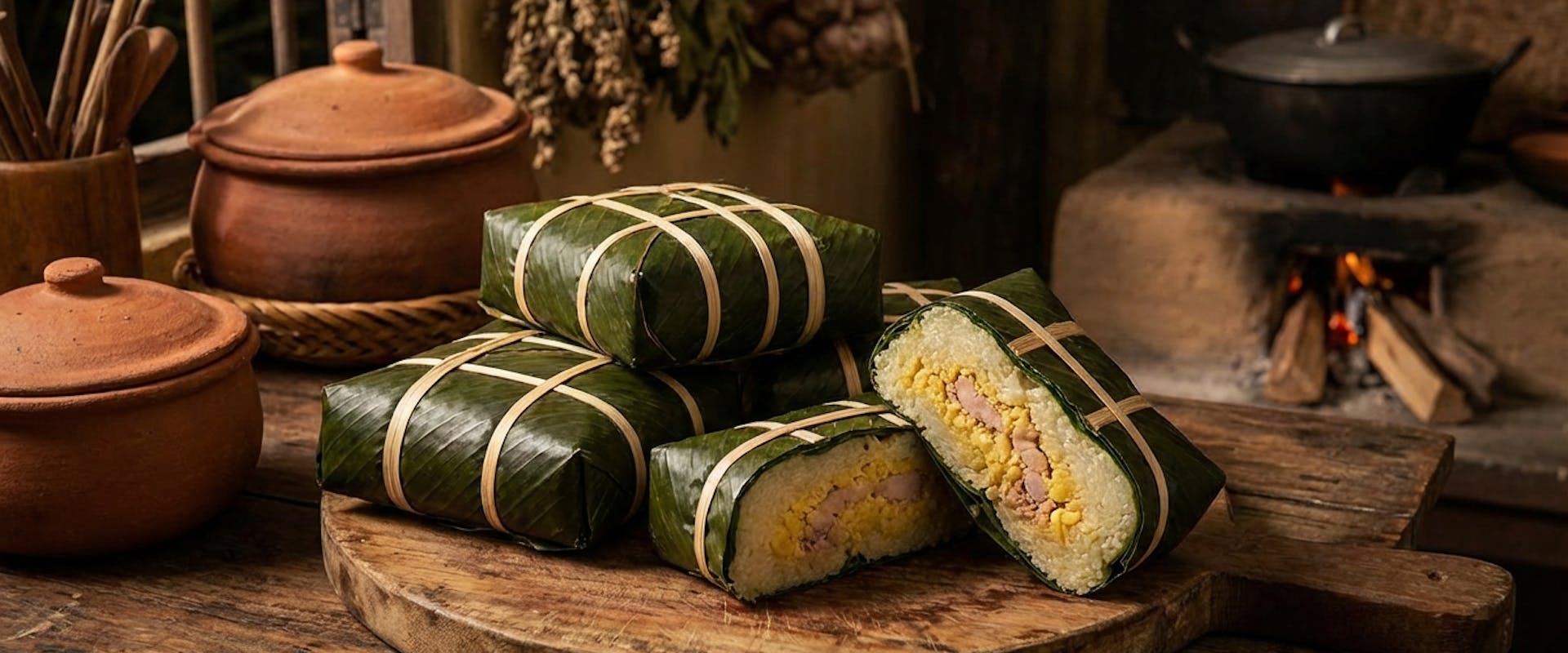

Bánh Chưng: The Art of Vietnamese Sticky Rice Cakes and the Legend of Lang Liêu
The water boils at 2 AM, steam rising from enormous pots that have bubbled for eight hours already. My host, Bà Hương, lifts the lid to check the bánh chưng nestled inside—twenty square packages wrapped in banana leaves, bound with bamboo strings in perfect geometric precision. The kitchen smells of earth and leaves and something fundamental: rice transforming through heat and time into tradition itself.
We are three days from Tết Nguyên Đán, Vietnam's Lunar New Year, and across the country, families perform this same ritual. Bánh chưng is not merely food—it is continuity made edible, a culinary thread connecting modern Vietnam to kingdoms that rose and fell centuries ago.
The Legend of Lang Liêu
Every Vietnamese child learns the story. The sixth Hùng King, seeking to choose a successor, challenged his twenty-two sons to find the most precious food to offer their ancestors. Twenty-one princes searched far and wide for exotic delicacies—rare birds, mountain herbs, delicacies from distant lands.
Prince Lang Liêu, the eighteenth son, was poorest of all. One night, a deity appeared in his dream and offered wisdom: "The most precious offerings need not be rare. Rice feeds our people. Make cakes that honor the earth and sky, using ingredients that sustain daily life."
Lang Liêu created two cakes. Bánh chưng—square like the earth, filled with sticky rice, mung beans, and pork, wrapped in green leaves. And bánh dày—round like the sky, made of pure white sticky rice, symbolizing heaven's blessing.
When the princes presented their offerings, the king tasted elaborate dishes of rare ingredients. But when he bit into Lang Liêu's humble cakes, he tasted something else entirely: the essence of Vietnamese agriculture, the sustenance of the people, the harmony between earth and sky.
Lang Liêu became king. Bánh chưng became tradition.
The Anatomy of Bánh Chưng
The cake's simplicity is deceptive. Three ingredients create something far greater than their sum:
Sticky rice (nếp): Soaked overnight until each grain swells with water, taking on a translucent quality. The rice forms the foundation—earth's bounty transformed through cultivation.
Mung beans (đậu xanh): Hulled, soaked, and steamed until they can be mashed into a golden paste. This layer represents prosperity, the richness within simplicity.
Pork belly (thịt lợn): Marinated with fish sauce, pepper, and shallots. The fatty, savory center that gives the cake its soul.
But the true art lies in the wrapper: banana leaves (lá dong), carefully selected, wiped clean, softened over flame until pliable. The leaves impart their grassy perfume to everything they touch, turning simple ingredients into something transcendent.
The Assembly Ritual
Bà Hương's kitchen table becomes an assembly line. Her daughter arranges banana leaves in cross patterns—two long strips perpendicular to two more, creating a square base. Beside her, her son measures sticky rice into a metal mold, the ancient tool that ensures each cake achieves perfect geometry.
The layering follows strict protocol:
- A base layer of sticky rice, pressed flat
- The mung bean paste, shaped into a square the size of your palm
- The seasoned pork, buried in the bean paste center
- More mung bean paste, sealing the meat completely
- A final layer of sticky rice, encasing everything
The leaves are folded with military precision—each edge meeting its opposite at exact angles, creating a perfect square. Bamboo strings are wound around the package in specific patterns, tight enough to maintain shape during twelve hours of boiling, loose enough to allow the rice to expand.
"If the wrapping is loose, the cake falls apart," Bà Hương explains, her hands moving with forty years of muscle memory. "Too tight, and the rice cannot become itself."
I watch her daughter's fingers struggle with the bamboo strings, the geometry refusing to cooperate. Bà Hương doesn't correct with words—only with gentle adjustments of the leaf angles, repositioning the string by millimeters. The next attempt holds.
This is how knowledge transfers in Vietnam: through observation, through corrected mistakes, through generations standing side by side at kitchen tables while the water begins to boil.
The Overnight Vigil
The wrapped cakes go into enormous pots—the kind that could bathe a child—filled with water. The stove roars to life. Bà Hương sets a timer, though she doesn't need it. Her internal clock, calibrated by decades of Tết preparations, knows precisely when to add water, when to adjust flame, when to rotate the cakes for even cooking.
"Twelve hours minimum," she says. "Some families do fourteen, sixteen. The longer they cook, the deeper the flavor becomes."
We settle in for the vigil—a practice as old as the cakes themselves. In villages across Vietnam, families stay awake all night, tending the pots while sharing stories, drinking tea, preparing other Tết foods. The overnight cooking serves practical purpose—sticky rice requires extended heat to fully transform—but the vigil is spiritual.
"We keep the cakes company," Bà Hương says. "Like watching over ancestors who watch over us."
At 4 AM, her son adds more water. At 6 AM, her daughter rotates the cakes. By 8 AM, the kitchen windows have fogged completely, steam condensing and running down the glass like tears. The banana leaves inside the pot have darkened to olive, and the first subtle fragrance begins to escape—rice and pork and something earthy, fundamental.
A Recipe to Remember
Bánh Chưng (Vietnamese Square Sticky Rice Cakes)
Yields: 10 cakes
Preparation time: 8 hours (mostly soaking/resting)
Cooking time: 12 hours
Special equipment needed:
- Bánh chưng mold (wooden or metal square frame, approximately 15cm x 15cm)
- Large cooking pot (at least 10 liters capacity)
- Bamboo string or twine
- Banana leaves (available at Asian markets, often frozen)
Ingredients:
For the rice:
- 2 kg glutinous sticky rice (nếp)
- 2 teaspoons salt
For the filling:
- 800g split mung beans, hulled
- 800g pork belly, cut into 10 pieces (approximately 80g each)
- 3 tablespoons fish sauce
- 2 tablespoons ground black pepper
- 4 shallots, minced
- 1 teaspoon salt
For wrapping:
- 40-50 large banana leaves (4-5 per cake)
- Bamboo string or kitchen twine
Preparation (Day Before):
-
Soak the sticky rice: Wash rice thoroughly until water runs clear. Cover with cold water and soak for 6-8 hours or overnight. Drain and mix with 2 teaspoons salt. Set aside.
-
Prepare mung beans: Wash mung beans and soak in water for 4 hours. Drain. Steam the beans for 30 minutes until soft enough to mash. While still warm, mash into a paste using a potato masher or food processor. Divide into 10 portions (approximately 80g each) and shape into square patties. Set aside.
-
Marinate pork: Cut pork belly into 10 rectangular pieces. Mix fish sauce, black pepper, minced shallots, and salt. Marinate pork in this mixture for at least 2 hours or overnight in refrigerator.
-
Prepare banana leaves: If using frozen leaves, thaw completely. Wipe each leaf clean with a damp cloth. Pass each leaf briefly over an open flame or hot stovetop (5-10 seconds per side) until the leaf becomes glossy and pliable. Cut into rectangles approximately 30cm x 30cm. You'll need 4-5 pieces per cake.
Assembly:
-
Create the base: Arrange 4 banana leaves in a cross pattern (two horizontal, two vertical), shiny side up, overlapping in the center. Place the square mold in the center.
-
Layer the cake:
- First rice layer: Press approximately 200g sticky rice into the mold, covering the bottom evenly (about 2cm thick)
- Mung bean layer: Place one mung bean patty in the center
- Pork layer: Press one marinated pork piece into the center of the mung bean
- Second mung bean layer: Cover the pork completely with mung bean paste
- Final rice layer: Add another 200g sticky rice on top, pressing firmly to create a uniform square
-
Wrap the cake: Remove the mold carefully. Fold the banana leaves over the cake—first the horizontal leaves, then the vertical, creating a tight square package. Use additional leaf pieces to patch any gaps (the package must be completely sealed).
-
Tie with string: Wrap bamboo string around the package lengthwise, then widthwise, creating a cross pattern. Tie securely. The string should be tight enough to hold the shape but not so tight that it cuts through the leaves.
Cooking:
-
Arrange cakes in a large pot, standing upright (they should fit snugly). Fill the pot with water to cover the cakes completely plus 3-4cm above.
-
Bring to a boil over high heat. Once boiling, reduce to a gentle simmer and cover with lid.
-
Cook for 12-14 hours, checking every 2 hours to ensure water level remains above the cakes. Add boiling water as needed—NEVER add cold water as this will stop the cooking process.
-
After 12 hours, remove one cake and let it rest for 15 minutes. Unwrap carefully and cut to check doneness. The rice should be fully translucent, sticky, and hold its shape. The filling should be cohesive, not crumbly.
-
Once done, remove cakes from water and let drain for 30 minutes. Keep the banana leaf wrapping intact.
Storage and Serving:
- Traditionally, bánh chưng can be kept at room temperature for 3-4 days (the cooking process sterilizes them)
- For longer storage, refrigerate for up to 1 week or freeze for up to 3 months
- To serve: Unwrap the cake and slice with a string (held taut between your hands) or a sharp knife dipped in water
- Serve at room temperature or gently pan-fried in a little oil until the outside is crispy
- Traditional accompaniment: pickled vegetables (dưa món) and Vietnamese sausage (giò chả)
Notes from the Kitchen:
- The success of bánh chưng depends heavily on the wrapping technique. Don't be discouraged if your first attempts don't hold perfect shape—even wonky cakes taste delicious
- Some families add a pinch of salt and pepper to the sticky rice for extra flavor
- The overnight cooking can be timed to finish in the morning—start at 6 PM for a 6 AM finish
- The banana leaves are edible but typically not eaten. Their purpose is to impart flavor and protect the cake during cooking
- Leftover bánh chưng is excellent pan-fried for breakfast—the rice develops a crispy crust while the filling stays creamy
The Morning After
At noon the next day, Bà Hương lifts the first cake from the pot. It emerges dark green, the leaves nearly black, the bamboo strings wet and swollen. She places it on a wooden board to cool, and we wait—another exercise in patience.
After thirty minutes, she unties the strings with a kitchen knife, carefully peeling back the layers of banana leaf. The cake inside has transformed completely. What went in as separate elements—rice, beans, pork—has become a unified square, each layer distinct yet inseparable, the rice now translucent and jade-tinted from the leaves, the mung beans golden and creamy, the pork rendered tender, its fat distributed throughout.
She cuts the cake with a taut string—the traditional method, cleaner than any knife. The cross-section reveals the architecture: rice, bean, pork, bean, rice. Perfect geometry. Edible philosophy.
The first bite is a revelation for someone who has never experienced bánh chưng. The rice is sticky but not gummy, each grain retaining its identity while contributing to the whole. The mung beans are buttery, savory, slightly sweet. The pork, after twelve hours of gentle heat, has surrendered all toughness, its fat enriching every other component.
But more than flavor, bánh chưng delivers texture—the yield of the rice, the creaminess of the beans, the tender pork, all wrapped in that elusive taste of banana leaves: grassy, slightly bitter, utterly irreplaceable.
The Tết Connection
Bánh chưng appears at Tết not by accident but by design. The square shape represents the earth from which Vietnam's agricultural culture springs. The green color symbolizes growth and renewal. The ingredients—rice, beans, pork—are the foundation of Vietnamese subsistence.
But beyond symbolism, bánh chưng performs crucial social function. Its labor-intensive preparation requires multiple generations working together. Grandmothers teach granddaughters the folding technique. Fathers and sons tend the overnight fires. The extended family gathers, not just to cook, but to reconnect.
"Bánh chưng is how we remember who we are," Bà Hương says, wrapping the cooled cakes in plastic for distribution to relatives. "Every year, the same recipe. The same hands, though they get older. The same stories told while we wait for the water to boil. This is what survives."
Beyond Tết: Everyday Bánh Chưng
While bánh chưng is most closely associated with Lunar New Year, these cakes appear year-round at Vietnamese markets, particularly in northern cities. Street vendors sell them from steamer baskets, often alongside bánh giầy (the round rice cakes from Lang Liêu's legend) and various bánh relatives—bánh tét (the cylindrical southern version), bánh u (triangle-shaped for the third lunar month), bánh dày (plain sticky rice rounds).
Leftover bánh chưng undergoes delicious transformation through pan-frying. Slice the cold cake into thick pieces and fry in a little oil until the outside develops a golden crust while the interior stays creamy. Serve with pickled mustard greens and a cup of strong Vietnamese coffee for a breakfast that connects contemporary Hanoi to ancient kingdoms.
The Lesson of the Square Cake
On my last evening, Bà Hương presses two bánh chưng into my hands—gifts for my journey. They're still warm, wrapped in their banana leaves, tied with bamboo strings that will leave marks on my wrists from carrying them through airports and across continents.
"When you eat these," she says, "remember that you're eating the same food Vietnamese people have eaten for thousands of years. Kings and farmers, soldiers and scholars, all sat down to bánh chưng. This is continuity you can taste."
Flying home, I think about Prince Lang Liêu and his divine dream. The lesson of bánh chưng is not that simple food is better than elaborate dishes—it's that the most meaningful foods are those that connect us to our communities, our landscapes, our past.
Vietnamese cuisine offers many spectacular dishes: phở with its complex broth, bún bò Huế with its layers of flavor, bánh xèo with its theatrical sizzle. But bánh chưng—that humble square of sticky rice—might be the most Vietnamese of all, not despite its simplicity but because of it.
Somewhere in Vietnam tonight, a grandmother is teaching her grandchild to fold banana leaves into perfect squares. A pot boils through the darkness. Bamboo strings are knotted with calloused hands. And the legend of Lang Liêu continues, not in museums or textbooks, but in kitchens where tradition transforms into dinner.
The sticky rice awaits. The leaves are ready. And if you listen carefully during Tết, you can hear the sound that unites all Vietnamese kitchens: the gentle bubble of water turning simple ingredients into history you can hold in your hands.