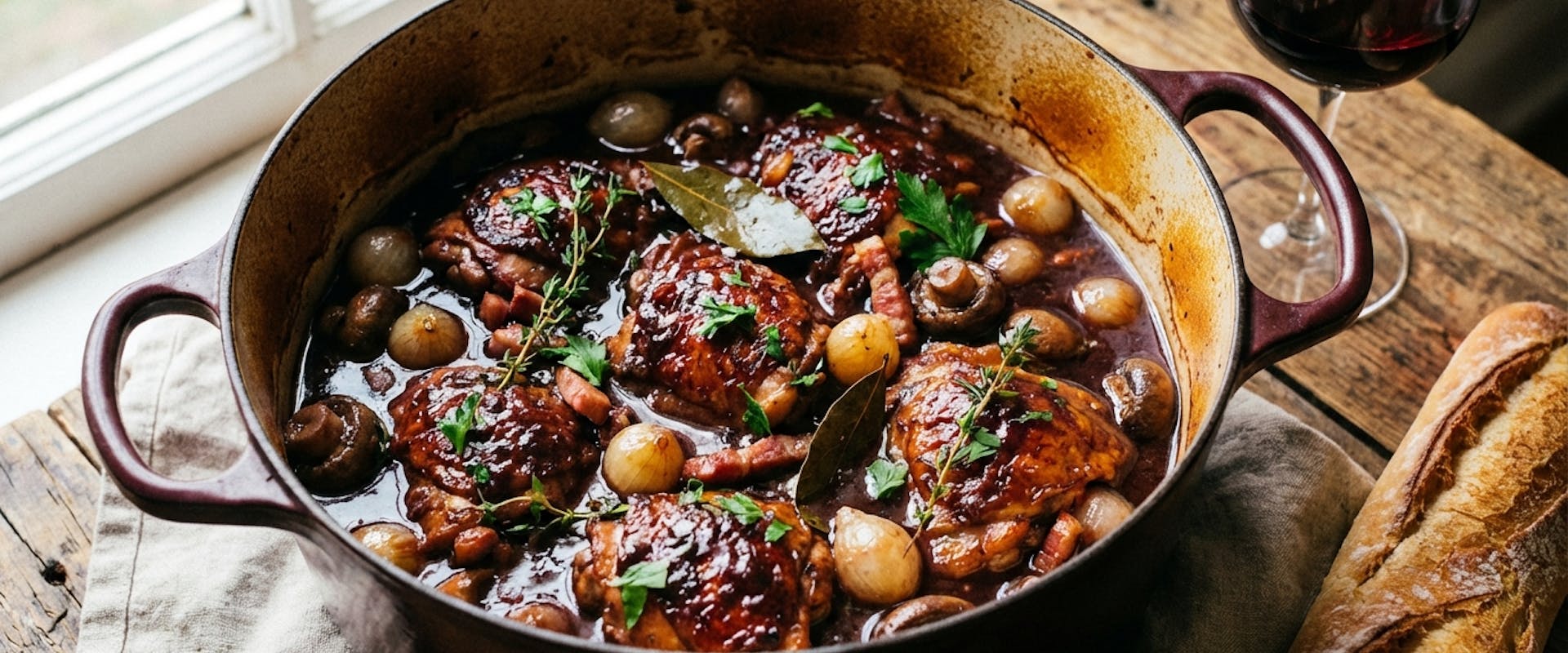

Wine, Time, and Tender Chicken: Mastering Coq au Vin in a Burgundy Kitchen
The rooster crows at dawn, but by the time I reach Madame Bertrand's kitchen in the Burgundy countryside, the sun has already painted the vineyards gold. She's been up since five, she tells me, preparing for today's lesson. On her wooden table: a chicken from her neighbor's farm, a bottle of Pinot Noir from the vineyard down the road, and vegetables from her garden that smell of earth and morning dew.
"Coq au vin is not cooking," she says, pouring wine into a heavy pot with the confidence of someone who has made this dish a thousand times. "It is transformation. You take a tough old rooster and wine that is too young, and through patience, you create something neither could become alone."
This is the magic of French country cooking—taking humble ingredients and, through technique and time, creating dishes that have sustained families for centuries.
The Legend of the Dish
Coq au vin's origins are debated, but most agree it arose from the necessity of dealing with roosters too old and tough for simple roasting. These birds, past their prime, required hours of slow braising to become tender. The solution? Wine, which both tenderizes and flavors, transforming sinew into silk.
Some claim Julius Caesar feasted on coq au vin. Others credit it to medieval monasteries where monks perfected the art of cooking with wine. The truth likely lies somewhere in the French countryside, where resourceful cooks discovered that time, wine, and low heat could work miracles.
What we know for certain is that by the 20th century, chefs like Paul Bocuse and Julia Child had elevated this peasant dish to haute cuisine status, while home cooks kept the tradition alive in farmhouse kitchens like Madame Bertrand's.
The Wine Question
In Burgundy, the wine is non-negotiable: Pinot Noir, preferably from a local vineyard, preferably young and fruity rather than expensive and aged. "We cook with wine we would drink," Madame Bertrand insists. "But we do not waste good Chambertin in the pot. Save that for your glass."
The wine serves multiple purposes: its acidity helps break down the chicken's connective tissue, its tannins add depth, and its fruit notes concentrate during reduction, creating a sauce that tastes of the vineyard and the season.
Some recipes call for Burgundy exclusively, while others accept any good red wine. The purists argue that only Burgundy produces the authentic dish. The pragmatists counter that any decent Pinot Noir, Côtes du Rhône, or even Beaujolais works beautifully. Madame Bertrand? She uses what her neighbor makes, and it's always perfect.
The Technique: Slow and Low
Coq au vin cannot be rushed. The process takes hours, but most of that time is passive—the chicken braising gently while you tend to other tasks or simply sit with a glass of wine, enjoying the transformation.
The Marinade: Traditional recipes marinate the chicken in wine overnight with aromatics. Modern cooks often skip this step, but Madame Bertrand swears by it. "The wine begins its work while you sleep," she says. "By morning, the meat has opened itself to the flavors."
The Browning: Each chicken piece must be browned properly in bacon fat. This isn't just for color—the Maillard reaction creates complex flavors that form the foundation of the sauce. Madame Bertrand's chicken emerges from the pot deep golden, its skin crackling slightly, the bacon fat carrying notes of smoke.
The Aromatics: Pearl onions, mushrooms, lardons of bacon—these aren't garnishes but essential components. Each adds its own character. The onions turn sweet and tender, the mushrooms contribute earthiness, the bacon provides salt and smoke.
The Braise: This is where patience matters. The chicken returns to the pot with the wine, stock, tomato paste, and a bouquet garni. The liquid should barely bubble—"the surface should smile, not laugh," as Madame Bertrand puts it. Low and slow for two hours, until the chicken threatens to fall apart at the suggestion of a fork.
The Finish: The sauce must be perfect—thick enough to coat a spoon, glossy with reduced wine and butter, balanced between acidity and richness. Madame Bertrand finishes hers with a splash of cognac and a knob of cold butter whisked in at the end, creating a sauce that gleams like liquid silk.
A Recipe to Remember
Classic Coq au Vin
Ingredients:
For the chicken:
- 1 whole chicken (about 1.8kg), cut into 8 pieces
- 200g bacon lardons or thick-cut bacon, diced
- 24 pearl onions, peeled
- 300g button mushrooms, quartered
- 4 cloves garlic, crushed
- 750ml Pinot Noir or other red wine
- 250ml chicken stock
- 2 tablespoons tomato paste
- 2 tablespoons cognac or brandy
- 3 tablespoons butter
- 3 tablespoons flour
- Fresh thyme, bay leaves, and parsley for bouquet garni
- Salt and freshly ground black pepper
For serving:
- Fresh parsley, chopped
- Crusty bread or buttery mashed potatoes
Method:
Day Before (Optional but Traditional): Place chicken pieces in a large bowl with half the wine, crushed garlic, and bouquet garni. Cover and refrigerate overnight. Remove chicken from marinade, pat dry, and strain marinade, reserving liquid.
The Cooking:
In a large Dutch oven or heavy pot, cook bacon over medium heat until crispy. Remove with a slotted spoon and set aside, leaving fat in the pot.
Season chicken pieces generously with salt and pepper. Working in batches to avoid crowding, brown chicken in bacon fat until golden on all sides, about 4-5 minutes per side. Remove and set aside.
In the same pot, add pearl onions and brown for 5 minutes until caramelized. Remove and set aside. Add mushrooms and cook until golden, about 6 minutes. Remove and set aside.
If pot looks dry, add 1 tablespoon butter. Sprinkle in flour and stir for 2 minutes to create a roux. Pour in cognac (carefully—it may flame) and stir to deglaze.
Add wine (including marinade if you used it), chicken stock, and tomato paste. Stir well, scraping up any browned bits from the bottom. Add bouquet garni and bring to a simmer.
Return chicken pieces to pot along with the cooked bacon. The liquid should come about halfway up the chicken. Cover and simmer gently for 1 hour.
Add pearl onions and mushrooms. Continue simmering, covered, for another 45-60 minutes until chicken is fall-apart tender and sauce has reduced by about one-third.
Remove chicken, onions, and mushrooms to a serving platter and keep warm. Discard bouquet garni.
Increase heat and reduce sauce for 10 minutes until it coats the back of a spoon. Taste and adjust seasoning. Remove from heat and whisk in remaining 2 tablespoons cold butter until sauce is glossy.
Pour sauce over chicken, garnish with fresh parsley, and serve immediately.
Madame Bertrand's Tips:
- Use chicken thighs if you prefer all dark meat—they stay more tender
- Don't skip the overnight marinade if you have time—it makes a difference
- The sauce should be rich enough to coat the chicken but not gravy-thick
- Leftovers are even better the next day after flavors have married
The Sides
Coq au vin begs for accompaniments that can soak up its glorious sauce. In Burgundy, the classic pairing is either crusty bread for mopping or buttery mashed potatoes that serve as a creamy canvas for the wine-dark sauce.
Madame Bertrand makes her pommes purée with equal parts potato and butter—an extravagance that turns a simple mash into something ethereal. The potatoes are riced while still hot, then butter is beaten in until the mixture resembles whipped cream.
Another classic: egg noodles tossed with butter and parsley, their simplicity allowing the coq au vin to remain the star.
Some serve it with roasted root vegetables or braised cabbage, but purists argue these compete with the dish rather than complement it. Keep it simple: bread or potatoes, a green salad after, and wine—always wine.
The Wine Pairing
Should you serve the same wine you cooked with? In Burgundy, the answer is obvious: of course. A young, fruity Pinot Noir that echoes the flavors in the pot creates harmony between plate and glass.
But Madame Bertrand has a secret: she saves a slightly better bottle for the table. "The cooking wine does its work in the pot," she says. "The drinking wine does its work in your soul."
If Burgundy is beyond your budget, look for French Pinot Noir from other regions, Oregon Pinot, or even a fruit-forward Beaujolais. The key is bright acidity and red fruit notes that won't be overwhelmed by the rich sauce.
The Lesson of Burgundy
On my last evening, Madame Bertrand invites neighbors for dinner. The coq au vin has been simmering since afternoon, the kitchen filled with wine-dark perfume. We eat at a long table in her garden as the sun sets behind the vines.
The chicken falls apart at the touch of a fork. The sauce is everything wine and time can create together—complex, balanced, deeply satisfying. Conversation flows as freely as the wine, and I understand what makes this dish more than food.
Coq au vin is about transformation, yes. But it's also about gathering, about taking time in a world that demands speed, about respecting ingredients and techniques that have sustained communities for centuries.
As darkness falls and candles are lit, someone opens another bottle. The coq au vin is gone, but its spirit remains—that particularly French magic of turning the ordinary into the extraordinary through nothing more than patience, wine, and care.
The rooster will crow again tomorrow. The vines will continue their ancient cycle. And in farmhouse kitchens across Burgundy, someone will place a chicken in a pot with wine, beginning the transformation once more.